
Category: MOBILE APP DEVELOPMENT

For years, businesses have faced an uncomfortable choice: build a native mobile app for a premium user experience, or build a website for broader reach and easier maintenance. Native apps meant separate codebases for iOS and Android, expensive development cycles, and the constant battle to get users to actually download and keep an app installed. Websites, on the other hand, were accessible to everyone but often felt clunky, slow, and disconnected from the smooth, app-like experience users had come to expect on their phones.
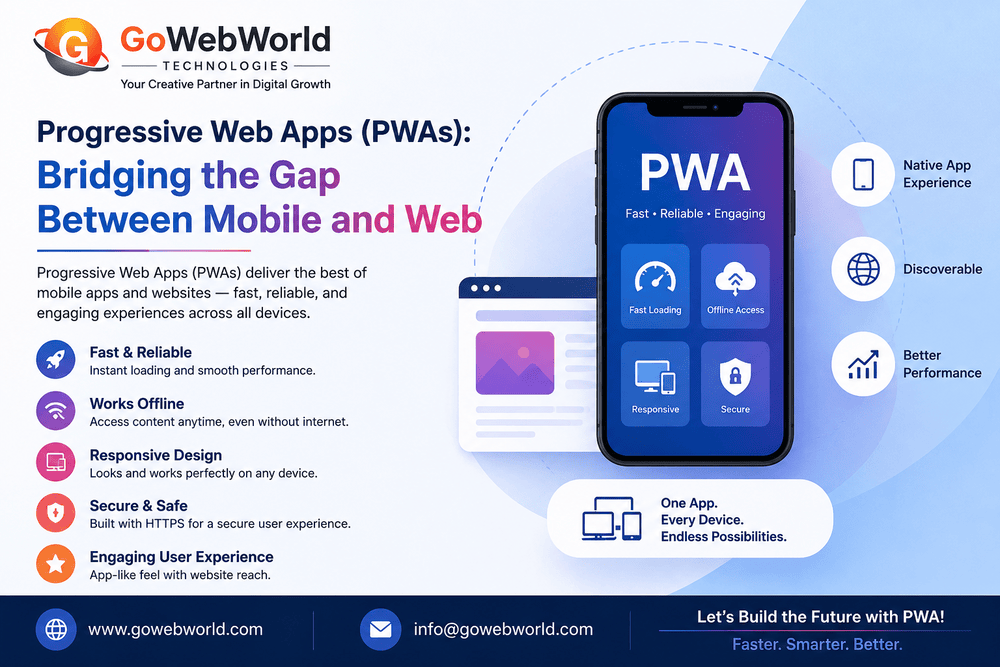
Progressive Web Apps (PWAs): Bridging the Gap Between Mobile and Web | GoWebWorld Technologies

Progressive Web Apps (PWA) emerged as the answer to this dilemma. By combining the best of both worlds, PWAs give users an app-like experience directly through the browser, without the friction of app store downloads or platform-specific development. Today, Progressive Web App Development has become one of the most practical and cost-effective strategies for businesses looking to reach mobile users without sacrificing performance or reach.

What Exactly Is a Progressive Web App?

A Progressive Web App is a website built using modern web technologies, but engineered to behave like a native application. It loads instantly, works offline or on unreliable networks, sends push notifications, and can be added to a user’s home screen just like a downloaded app. Yet underneath, it’s still a website, accessible through any browser and indexable by search engines.

This hybrid nature is what makes PWAs so powerful. A single codebase serves desktop and mobile users alike, eliminating the need to maintain separate iOS and Android applications. Companies like Twitter, Starbucks, Pinterest, and Uber have already adopted PWAs to boost engagement, reduce bounce rates, and improve conversions, proving that this technology isn’t just a trend but a genuine shift in how digital experiences are built.

The Core Technologies Behind PWAs

Three foundational technologies make Progressive Web Apps possible:

Service Workers act as a background script that runs separately from the main browser thread. They enable offline functionality by caching assets and data, allowing the app to load even without an active internet connection. Service workers also handle background sync and push notifications, two features that were once exclusive to native apps.

Web App Manifest is a simple JSON file that tells the browser how the app should behave when installed on a device. It defines the app’s name, icons, theme colors, and display mode, giving the PWA its native, full-screen appearance rather than looking like an ordinary browser tab.

HTTPS ensures that all communication between the user and the app is secure. Since service workers can intercept network requests, PWAs must be served over a secure connection to prevent malicious tampering.

Together, these elements create an experience that feels indistinguishable from a native app, while retaining the openness and accessibility of the web.

Why Businesses Are Investing in PWAs

The appeal of Progressive Web Apps goes beyond technical elegance. Businesses are drawn to PWAs because they solve real, practical problems.

Improved Performance: PWAs are designed to load quickly, even on slow or unstable networks. This speed translates directly into better user retention, since studies consistently show that users abandon slow-loading pages within seconds.

No App Store Barriers: Traditional apps require users to visit an app store, download the app, and wait for installation. PWAs remove this friction entirely. Users can start using the app immediately from a browser and choose to install it later with a single tap, no app store approval process required.

Cost Efficiency: Building and maintaining separate native apps for multiple platforms is expensive. A PWA, built once with web technologies, works across devices and operating systems, significantly cutting development and maintenance costs.

Better Engagement: With push notifications and home screen icons, PWAs re-engage users in ways traditional websites cannot. This closes the gap between the engagement levels of native apps and the accessibility of the web.

SEO Advantages: Since PWAs are still websites, they remain fully crawlable and indexable by search engines, something native apps cannot offer. This makes them an excellent tool for businesses that rely on organic search traffic.

Common Use Cases for PWA Development

Progressive Web Apps are particularly effective for e-commerce platforms, where fast load times and offline browsing can directly influence sales. Media and publishing sites benefit from PWAs by delivering content quickly, even in low-connectivity regions. Travel and booking platforms use PWAs to allow users to browse itineraries offline and receive timely notifications about bookings. Even enterprise tools and internal dashboards have adopted PWA principles to give employees a consistent, app-like experience across devices.

Choosing the Right PWA Development Services

While the concept of Progressive Web Apps is straightforward, building one that performs well requires careful planning around caching strategies, offline data handling, responsive design, and cross-browser compatibility. This is where professional PWA Development Services become valuable. Experienced development teams understand how to architect service workers efficiently, optimize manifest configurations, and ensure the app meets platform-specific installation criteria on both Android and iOS.

A skilled development partner will also help balance performance with functionality, ensuring the PWA doesn’t just look like an app but truly behaves like one, complete with smooth animations, reliable offline support, and fast interactions. For businesses without in-house expertise in service workers or modern JavaScript frameworks, partnering with a specialized team can significantly reduce development time and avoid costly technical missteps.

The Road Ahead

As mobile usage continues to dominate global internet traffic, the demand for experiences that are fast, reliable, and installable without app store dependency will only grow. Progressive Web Apps represent a maturing of web technology, one that finally allows developers to deliver native-like experiences without abandoning the openness of the web.

For businesses weighing their options between native development and traditional websites, Progressive Web App Development offers a compelling middle ground: broader reach, lower costs, and an experience that keeps users coming back. Whether you’re building an e-commerce storefront, a content platform, or an enterprise tool, investing in the right PWA Development Services today could be the smartest way to future-proof your digital presence.

In today’s fast-paced digital landscape, businesses are constantly looking for ways to innovate and scale efficiently. Traditional web and application development often require substantial time, expertise, and resources. However, the advent of no-code and low-code platforms is revolutionizing the development process, empowering businesses to build robust digital solutions without deep technical expertise. For companies like GoWebworld Technologies, a leader in web development, understanding and leveraging these platforms is key to staying ahead of the curve.

The Rise of No-Code and Low-Code Platforms What It Means for Businesses

What Are No-Code and Low-Code Platforms?

No-code and low-code platforms are development tools designed to simplify the creation of websites, applications, and other digital solutions. While they share similarities, their distinctions are important:

  • No-Code Platforms: These platforms allow users with no technical skills to build applications using visual drag-and-drop interfaces. Popular examples include Wix, Bubble, and Webflow.
  • Low-Code Platforms: While similar in functionality, low-code platforms cater to users with some technical knowledge, offering more customization through minimal coding. Examples include OutSystems and Mendix.

Both platforms focus on democratizing development, making it accessible to businesses of all sizes.

Why Are These Platforms Gaining Popularity?

The rise of no-code and low-code platforms can be attributed to several factors:

  1. Faster Time-to-Market: Traditional development can take weeks or months. These platforms significantly reduce development time, allowing businesses to deploy solutions quickly.
  2. Cost-Effectiveness: Hiring a development team can be expensive. No-code and low-code platforms eliminate the need for extensive technical expertise, reducing overhead costs.
  3. Accessibility: With intuitive interfaces, these platforms empower non-developers, such as marketers or business managers, to create and manage digital solutions.
  4. Scalability: As businesses grow, these platforms offer features that allow for easy scaling, ensuring the solutions remain robust and functional.
  5. Customizable Integrations: Many platforms come with pre-built integrations, making it easy to connect to third-party tools like CRMs, payment gateways, and analytics platforms.

How No-Code and Low-Code Platforms Benefit Businesses

For businesses, the adoption of no-code and low-code platforms offers several advantages:

  1. Increased Agility: Businesses can quickly adapt to changing market demands by iterating on applications and websites without waiting for long development cycles.
  2. Empowered Teams: Non-technical employees can take charge of development, fostering creativity and collaboration across departments.
  3. Focus on Core Competencies: By simplifying development, businesses can allocate more resources to core functions like strategy, marketing, and customer service.
  4. Enhanced Customer Experience: Faster development cycles mean businesses can respond to customer needs promptly, delivering tailored experiences.

Use Cases for No-Code and Low-Code Platforms

No-code and low-code platforms are versatile, catering to a range of business needs:

  • E-Commerce: Platforms like Shopify enable businesses to set up online stores with ease, integrating payment gateways and inventory management tools.
  • Websites and Landing Pages: Tools like Webflow and Wix allow businesses to create visually appealing websites optimized for performance.
  • Internal Tools: Companies can use platforms like Airtable and Zapier to build internal workflows and automate processes.
  • Mobile Applications: Solutions like Glide and Adalo empower businesses to create mobile apps for Android and iOS without traditional coding.

The Role of GoWebWorld Technologies in This Evolution

While no-code and low-code platforms have simplified development, they are not without challenges. Businesses often need expert guidance to:

  • Choose the right platform based on their specific needs.
  • Ensure that the final product aligns with brand identity and functionality requirements.
  • Integrate these platforms with existing systems and workflows.

As a leader in web development, Gowebworld Technologies bridges the gap between simplicity and sophistication. By combining the power of no-code and low-code platforms with expert insights, the company helps businesses:

  1. Identify Optimal Solutions: From e-commerce to enterprise-level applications, Gowebworld Technologies assists clients in selecting platforms that align with their goals.
  2. Customization and Branding: The team ensures that applications built on no-code or low-code platforms reflect the client’s unique brand identity.
  3. Integration and Optimization: GoWebWorld Technologies seamlessly integrates no-code and low-code solutions with existing systems, enhancing overall functionality.
  4. Training and Support: The company provides ongoing training and support, enabling businesses to maximize the potential of these platforms.

Challenges and Limitations

Despite their advantages, no-code and low-code platforms come with certain limitations:

  • Scalability Concerns: While these platforms support growth, they may not handle complex, enterprise-level needs without significant customization.
  • Limited Customization: No-code solutions often lack the flexibility required for highly specific functionalities.
  • Dependency on Platforms: Businesses may face challenges if a platform discontinues support or changes pricing structures.

This is where partnering with experts like GoWebWorld Technologies becomes invaluable. The team’s technical expertise ensures that businesses can overcome these challenges while leveraging the benefits of these platforms.

The Future of No-Code and Low-Code Platforms

The future of web development is undeniably intertwined with no-code and low-code platforms. As these tools continue to evolve, they will integrate advanced features like AI, machine learning, and blockchain, further expanding their capabilities. Businesses that adopt these platforms today will be better positioned to innovate and compete in the digital age.

For companies looking to stay ahead, partnering with a trusted name like GoWebWorld Technologies can make all the difference. By combining the simplicity of no-code and low-code tools with expert guidance, businesses can achieve digital transformation without compromising on quality or performance.

Integrating AI into your Taxi Booking App can significantly enhance and uplift your services, offering a more efficient, personalized, and convenient experience for both passengers and drivers. Here are some ways to achieve this:

Smart Route Optimization:

Utilize AI algorithms to analyze real-time traffic data, historical trip patterns, and current demand to suggest the most optimal routes for drivers. This reduces travel time, fuel consumption, and overall costs, leading to quicker pick-ups and drop-offs for passengers.

Predictive Demand and Supply:

AI can forecast the demand for rides in specific areas and at particular times, enabling you to allocate drivers proactively and reduce passenger waiting times. By accurately predicting peak hours, you can ensure enough drivers are available during high-demand periods.

Personalized User Experience:

Implement AI-based recommendation systems to personalize the user experience for passengers. The app can suggest favorite or frequently visited locations, preferred vehicle types, and even offer customized discounts based on past behavior, leading to increased customer satisfaction and loyalty.

Real-time Driver Monitoring:<

Utilize AI-powered driver monitoring systems to ensure safe and responsible driving behavior. This can include monitoring speed limits, sudden braking, and adherence to traffic rules. Identifying and addressing any unsafe practices will enhance passenger safety.

Voice Assistance:

Incorporate AI-powered voice assistants to allow passengers to book rides, inquire about trip details, or give specific instructions using natural language. This hands-free interaction enhances accessibility and makes the booking process more seamless.

Driver Allocation Optimization:

Implement AI algorithms to intelligently assign drivers to nearby ride requests, taking into account factors like driver location, ride distance, and historical trip preferences. This leads to reduced wait times for passengers and optimal earnings for drivers.

Automatic Fare Estimation:

Utilize AI to estimate fares accurately based on distance, time, and other relevant factors. This transparency helps build trust with passengers and avoids any disputes over pricing.

Emotion and Sentiment Analysis:

Implement AI-powered sentiment analysis to gauge passenger satisfaction and driver behavior. Identifying areas of improvement and addressing negative experiences promptly can lead to improved service quality.

Fraud Detection and Prevention:

tilize AI to detect and prevent fraudulent activities, such as fake accounts, false reviews, or suspicious payment transactions, ensuring a secure environment for both drivers and passengers.

Autonomous Vehicles (Future Consideration):

Although still in development, AI-driven autonomous vehicles could revolutionize the taxi industry by offering self-driving taxis. By integrating this technology into your app once it becomes viable, you can provide an even more innovative and efficient service.

By integrating AI into your Taxi Booking App, you can enhance the overall user experience, optimize operations, and stay ahead in a competitive market, thereby uplifting your services to better serve your customers and drivers.

Contact Us

Gowebworld Technologies
8043 WENTE WAY,
SACRAMENTO, CA,95829, USA.

+1 (916) 757 9219

info@gowebworld.com